

The best pellet grills offer something truly special: the rich, smoky flavor of an old-school pit combined with the pinpoint accuracy of a modern convection oven. For anyone serious about their outdoor kitchen, they've become an essential piece of equipment. The top-tier models, built with robust stainless steel, managed by advanced PID temperature controllers, and connected via WiFi, are the pinnacle of today's grilling technology. It's this fusion of convenience and culinary firepower that has cemented their place as a cornerstone of high-end outdoor entertaining.
Why Pellet Grills Are an Essential Upgrade
Think of a modern pellet grill less as an appliance and more as a complete, automated cooking system. It works by burning compressed hardwood pellets, which are fed into a fire pot by a slow-turning auger. This simple mechanism allows it to hold a precise temperature for hours on end, turning what used to be a hands-on chore—like smoking a brisket or slow-roasting a turkey—into a "set-it-and-forget-it" process.
What does that mean in practice? It means you can produce barbecue that rivals competition pitmasters without spending your entire day fussing with vents, charcoal, and wood chunks. That right there is the real magic of a premium pellet grill.
Versatility Beyond Grilling
One of the biggest draws for a high-end pellet grill is its sheer versatility. This isn't just a machine for one type of cooking; it's a true culinary workhorse that can handle almost anything you throw at it. That multi-functionality simplifies your setup and dramatically expands your menu, making it a crucial component when designing your space. For more on building out your setup, our guide on outdoor kitchen essentials has plenty of ideas.
A single pellet grill gives you the power to:
- Smoke: Lock in temperatures around 225°F for perfect low-and-slow ribs, pork butt, and brisket.
- Bake: Use it like a wood-fired oven for pizzas, fresh bread, and even cobblers or cookies.
- Roast: Deliver perfectly roasted chickens, root vegetables, and prime rib, all infused with a subtle, wood-fired aroma.
- Grill: Of course, it still handles the backyard classics like burgers and steaks with ease.
This all-in-one capability means you don't need a separate smoker, oven, and grill, making it an incredibly smart and efficient centerpiece for any outdoor kitchen.
The Rise of Automated Perfection
The explosion in popularity for these grills isn't just something we're seeing in the field; the numbers back it up. The global pellet grill market was already valued at $585.385 million in 2021 and is on track to hit $761.6 million by 2025. This growth is driven by people who want amazing food without the hassle. Features like digital temperature control and WiFi connectivity have turned these grills into a smart investment for anyone elevating their outdoor living space. You can dive deeper into the pellet grill market findings to see the trends.
This shift really points to a bigger change in outdoor cooking. People now expect professional-level results without the years of practice or the constant babysitting that traditional methods demand. A pellet grill absolutely delivers on that.
At the end of the day, investing in a quality pellet grill isn't just about the hardware. It's about buying back your time and guaranteeing incredible results, every time. It gives you the freedom to entertain with confidence, knowing the food is taken care of while you focus on what actually matters—enjoying the company of your friends and family.
What Goes Into a High-End Pellet Grill?
When you’re looking at top-tier pellet grills, the real difference isn’t just a few extra features—it’s baked right into the engineering and the metals used. The genuine value comes from construction choices that guarantee unwavering performance, cook after cook, year after year. It's like comparing a meticulously engineered sports car to a basic daily driver. Both will get you from A to B, but one is built for precision, power, and an experience that's in a different league entirely.
That same philosophy is what separates a truly great pellet grill from the rest. Entry-level models often use thin, powder-coated steel. It looks sharp on the showroom floor, but it’s prone to chipping, peeling, and rusting once it faces a few seasons of rain and intense heat. A premium grill, on the other hand, is built like a tank from heavier gauge steel, designed to handle the abuse of high temperatures and the great outdoors.
This chart breaks down how that superior build quality translates into real-world benefits for you, the cook.
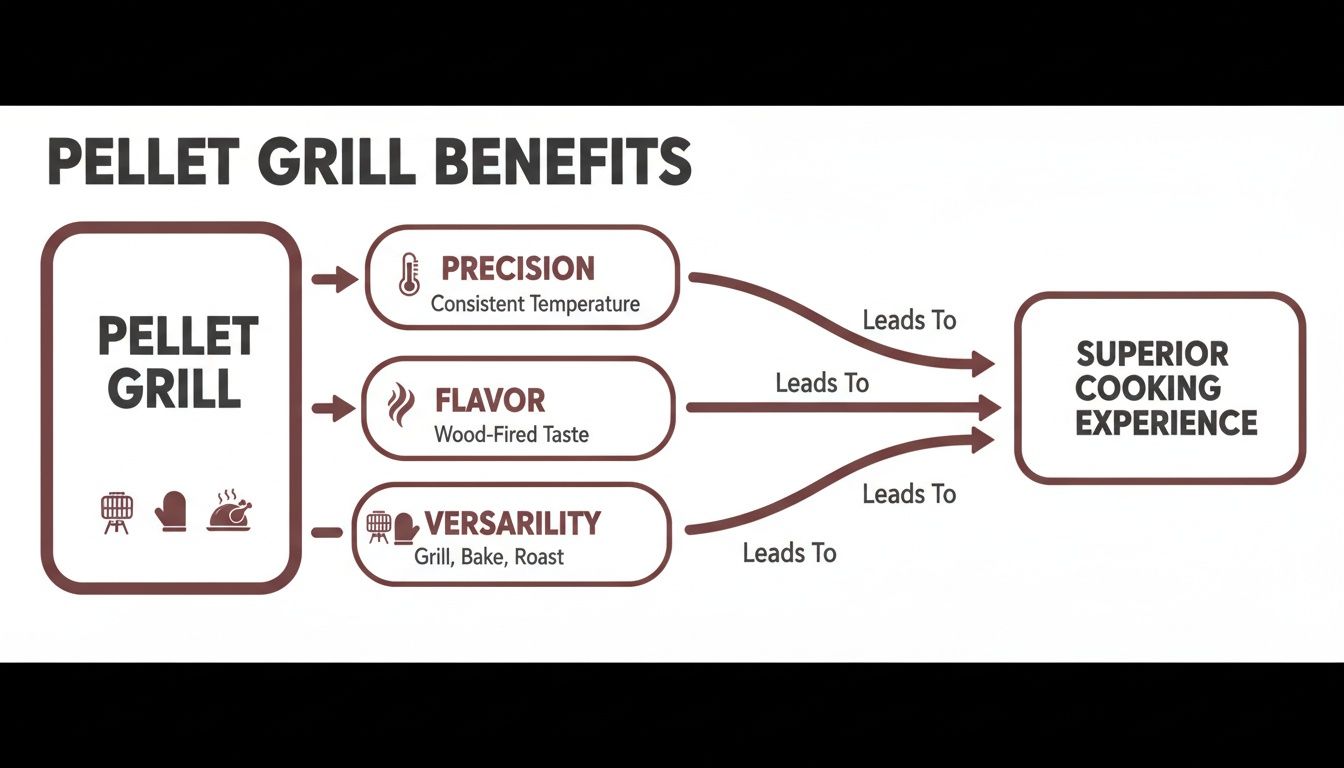
As you can see, it all starts with precision engineering. That precision is what gives you incredible flavor and the versatility to cook just about anything.
The Gold Standard: Materials That Last
At the core of any serious pellet grill is the metal it’s made from. While you'll see various grades of steel out there, the undisputed champion for longevity and sheer toughness is 304 stainless steel. This specific grade has a high concentration of chromium and nickel, making it incredibly resistant to rust and corrosion. It’s the ideal choice, especially if you live in a humid or coastal climate where salt is in the air.
This is much more than just a cosmetic upgrade. A grill made from 304 stainless will hold its structural integrity and sharp looks for a decade or more, long after painted steel has started to fail. You're not just buying an appliance; you're investing in a reliable centerpiece for your outdoor kitchen.
The Secret to Consistency: Insulation and Temperature Stability
Rock-solid temperature control is the holy grail of good barbecue, and that stability begins with quality insulation. The best pellet grills all feature double-walled, insulated construction. Think of it like a high-end Yeti cooler or your premium indoor oven.
This design creates an air gap that acts as a powerful thermal barrier. It locks heat inside the cooking chamber, which makes the grill incredibly efficient and—most importantly—helps it hold a steady temperature no matter what the weather is doing. A cold winter day or a gusty evening won’t throw it off course.
This efficiency pays off. Your grill will burn through fewer pellets to hold its temperature, which saves you money on fuel over its lifetime. Even better, it prevents the frustrating temperature swings that can dry out a brisket or ruin a delicate piece of fish. This is a non-negotiable feature when you're choosing from the best outdoor kitchen grills on the market.
The Brain of the Operation: The PID Controller
If the build quality is the grill’s body, the controller is its brain. Standard grills often use very basic controllers that function like a simple home thermostat—they turn the auger on when the temp drops and off when it rises. This crude on/off cycle can create temperature fluctuations of 20-30°F, which is way too much for true precision cooking.
Premium grills have a secret weapon: the PID (Proportional-Integral-Derivative) controller. This is a smart system that uses a sophisticated algorithm to constantly learn the grill's unique thermal properties. It makes hundreds of tiny, real-time adjustments to the pellet feed and fan speed to nail your target temperature.
- Proportional: Adjusts based on how far the current temperature is from your target.
- Integral: Looks at past performance to correct for small, persistent errors.
- Derivative: Anticipates where the temperature is headed and makes changes before it gets there.
The result? A grill that holds its temperature within an astonishingly tight 5°F range of your set point. This is the kind of technology that has fueled the incredible growth of the wood pellet grill market, which hit $1.33 billion in 2024 and is on track for $1.45 billion in 2025. Home cooks want foolproof, repeatable results, and PID controllers deliver.
Critical Components Under the Hood
Beyond the main body and the controller, a few other internal components make a massive difference. The auger, the corkscrew that feeds pellets into the fire pot, needs to be built tough to prevent jams. The size of the pellet hopper is also key—a bigger hopper means you can run an overnight brisket smoke without having to wake up in the middle of the night to refill it.
Finally, a smart grease management system is essential. The best designs channel grease away from the flames and into an external catch can. This does more than just make cleanup easier; it drastically reduces the risk of dangerous flare-ups, so your cooking experience is safer and more enjoyable from start to finish.
To help you see the difference at a glance, this table breaks down what you get when you step up to a premium, UrbanManCaves-approved pellet grill.
Key Pellet Grill Features Comparison
| Feature | Standard Pellet Grills | Premium (UrbanManCaves-Approved) Grills |
|---|---|---|
| Primary Material | Painted or powder-coated thin-gauge steel | Heavy-gauge 304 stainless steel for maximum durability and rust resistance |
| Insulation | Single-walled construction, susceptible to weather | Double-walled, insulated construction for superior heat retention and fuel efficiency |
| Temperature Controller | Basic thermostat-style controller (20-30°F swings) | Advanced PID controller for ultra-precise temperature control (within 5°F) |
| Grease Management | Simple drip tray, often prone to flare-ups | Engineered system to channel grease away from the fire pot into an external catch |
| Internal Components | Standard-duty auger and smaller hopper | Heavy-duty auger, larger hopper for long cooks, and robust internal parts |
| Expected Lifespan | 3-5 years with regular use | 10+ years, designed as a long-term investment |
As the table shows, investing in a premium model isn't about luxury for its own sake. It’s about buying a machine engineered for better performance, greater reliability, and a far more satisfying cooking experience that will last for years to come.
Choosing the Right Size Grill for Your Space
Picking the right size for your new pellet grill is about so much more than just the cooking capacity. It's about designing your outdoor living space. You're integrating a serious culinary tool, and the goal is to make it feel like a natural extension of your home—one that fits how you entertain and enhances the flow of your patio or deck. Get it right, and it feels seamless. Get it wrong, and it’s just a clunky appliance in the way.
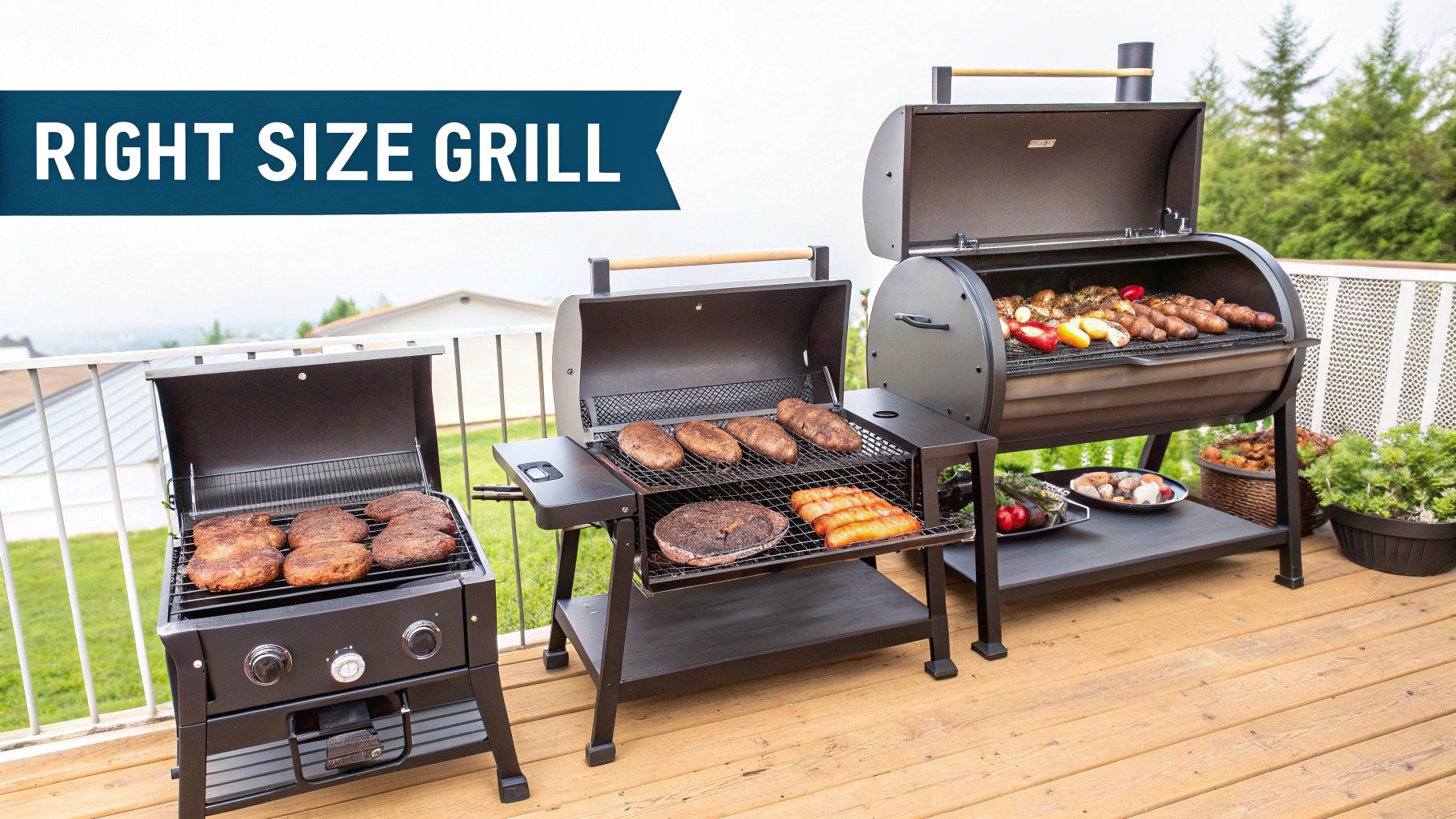
The first step is to forget about abstract numbers like "square inches" for a moment. Instead, think about your real-world use. Are you typically cooking for your immediate family on a weeknight? Or are you the one hosting the entire neighborhood for the big game? Answering that question honestly will guide you to the right size better than any spec sheet.
Translating Square Inches to Servings
Okay, now let's talk about those numbers. Grill manufacturers love to talk about the primary cooking area in square inches, but what does that actually get you? A smaller grill might seem fine for a few burgers, but it’ll fill up fast if you ever want to smoke a full packer brisket or a few racks of ribs.
Here’s a practical way to think about capacity:
- Small Grills (Under 500 sq. in.): This is perfect for couples or small families. You can easily fit a dozen burgers, a whole chicken, or one big rack of ribs. It's a great choice for more intimate cooks, but you'll feel the squeeze on larger smoking projects.
- Medium Grills (500-800 sq. in.): For most people, this is the sweet spot. It gives you enough room to comfortably cook for a party of 10-12. Think two briskets, four to six racks of ribs, or that big holiday turkey without any issues.
- Large Grills (800+ sq. in.): This is for the serious entertainer. These beasts are built to handle massive cooks, letting you smoke multiple pork butts and briskets at the same time for huge parties or even small catering gigs.
My advice? It's always better to have a little more space than you think you need. Overcrowding the grill is a classic mistake. It chokes off airflow, which leads to uneven cooking and a weaker smoke flavor—the exact things you’re buying a premium pellet grill to avoid.
Freestanding vs. Built-In Pellet Grills
Your next big decision comes down to how the grill will physically exist in your space. This choice shapes not just the look but the entire feel and function of your outdoor kitchen.
Freestanding Grills give you total flexibility. You can wheel them around the patio to follow the sun, make room for more seating, or just store them away in the off-season. They’re completely self-contained, usually with handy side shelves and storage, making them a fantastic all-in-one solution if you aren't building a full outdoor kitchen.
Built-In Grills, on the other hand, are the mark of a truly custom, high-end outdoor kitchen. These units are designed to drop right into a countertop, creating that clean, seamless look you see in magazines. This approach lets you design the perfect culinary workflow, with prep areas, storage, and refrigeration exactly where you need them. If you're building a permanent setup, exploring ideas for a custom outdoor kitchen island is absolutely the way to go for a stunning and functional entertainment hub.
Planning Your Grill Placement and Workflow
Where you put the grill is just as important as which one you buy. A common misstep is sticking it in a forgotten corner, disconnected from where everyone is hanging out. Your grill should be a centerpiece of the action, not an afterthought.
Keep these essential planning tips in mind:
- Safety Clearances: First and foremost, read the manual. Every grill has specific recommendations for clearance from combustible materials like siding, deck railings, and overhead covers. A minimum of 24-36 inches is a pretty standard rule of thumb.
- Ventilation: Remember, these things produce a lot of smoke. You need to place the grill somewhere with plenty of airflow, well away from open windows or doors, so you don't smoke out your house.
- Ergonomic Workflow: Put on your chef's hat for a minute. Your grill should be part of a natural "work triangle" with easy access to a prep surface, a sink, and your fridge or cooler. This makes the whole process of cooking outside feel intuitive and enjoyable, not like a chore.
By really thinking through how you cook, what type of grill fits your lifestyle, and the layout of your space, you’ll land on a grill that not only makes incredible food but makes your entire outdoor experience better.
5. Mastering The Art Of Wood Pellet Flavors
The real magic of a pellet grill isn't in the steel or the digital controller; it’s in the wood it burns. While the grill provides the precision heat, the pellets deliver the soul. This is what transforms a simple meal into something truly memorable.
Learning to harness these flavors is what separates good grilling from genuine culinary craftsmanship. It's the key that unlocks the full potential of your grill.
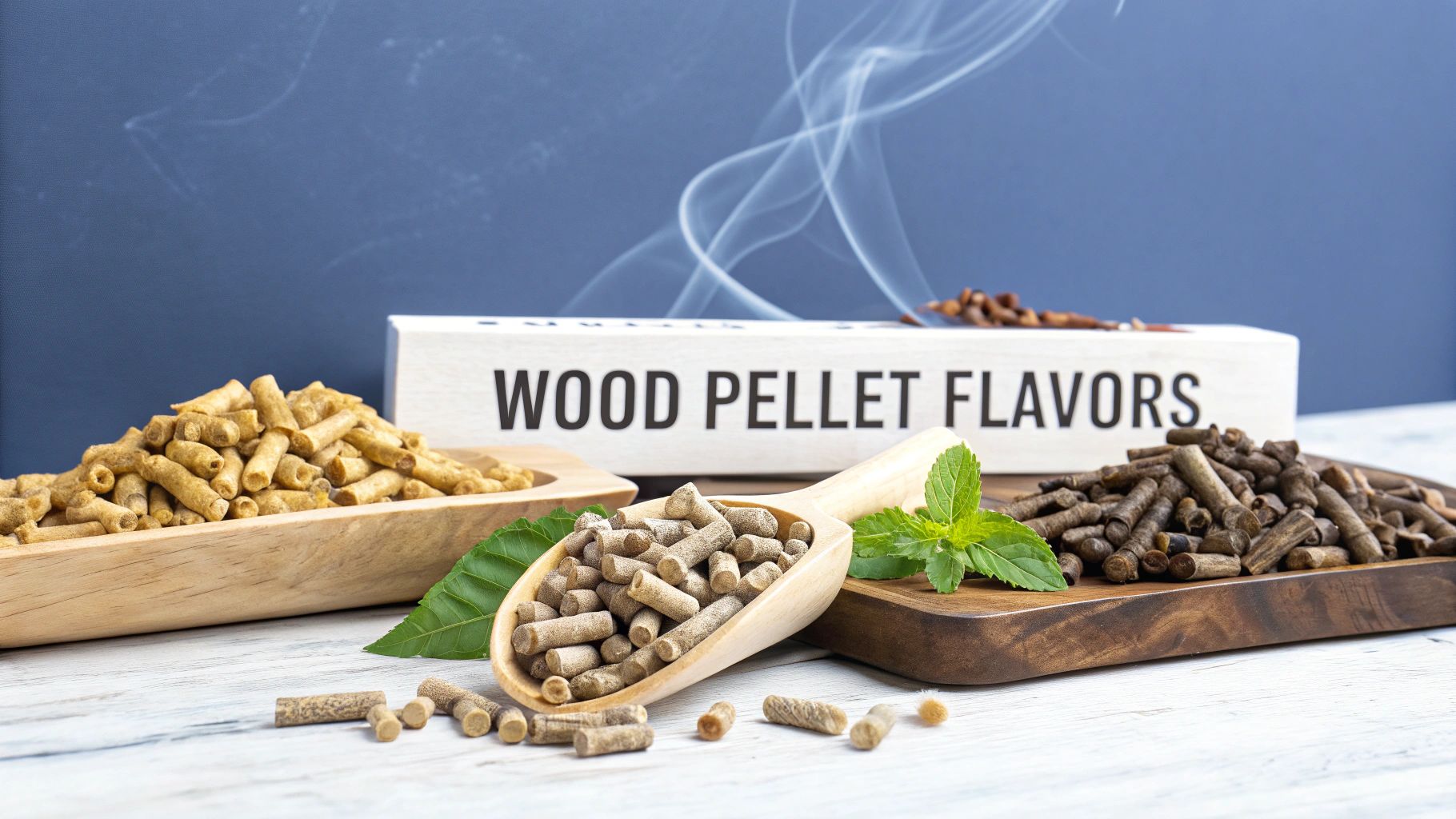
It all starts with choosing the right fuel. Let's be clear: not all wood pellets are created equal. The market is flooded with options, but they really boil down to two types: 100% hardwood pellets and blended pellets that use cheap filler woods or artificial flavor oils.
For authentic, clean smoke flavor, premium 100% hardwood is the only real choice.
Cheaper alternatives often burn inconsistently and can produce a bitter, acrid smoke that will taint your food. Think of it like cooking with a fine wine versus a cheap cooking sherry. Sure, both will get the job done, but the quality of the final result will be worlds apart. For anyone serious about flavor, investing in quality fuel is non-negotiable.
Pairing Wood Flavors With Your Food
Once you’ve committed to quality pellets, the real fun begins: pairing the right wood with the right food. Each type of hardwood has a unique smoke profile, ranging from mild and sweet to bold and pungent. Getting the match right is how you complement and elevate your food instead of overpowering it.
To make things easier, here's a quick guide to some of the most popular wood flavors and what they do best.
Wood Pellet Flavor Pairing Guide
| Wood Pellet Type | Flavor Profile | Best Paired With |
|---|---|---|
| Hickory | Strong, bacon-like, classic BBQ smokiness | Brisket, pork shoulder, ribs, beef |
| Mesquite | Bold, intense, earthy, and powerful | Steaks, burgers, Tex-Mex style beef |
| Apple | Light, sweet, mild, and subtly fruity | Pork (ribs, loin), chicken, turkey, baked goods |
| Cherry | Richer than apple, dark fruit notes | Poultry, pork, beef. Adds a beautiful dark color. |
| Pecan | Nutty, rich, milder than hickory | Brisket, poultry (especially holiday turkey), fish |
| Oak | Medium smokiness, the "go-to" versatile wood | Beef, brisket, lamb, sausages, fish |
| Alder | Very light, delicate, and slightly sweet | Salmon, trout, other delicate fish, poultry |
This table is a great starting point, but don't be afraid to experiment. Blending different pellets is where you can start to create your own signature flavors.
The goal is harmony. You want the smoke to be a supporting actor that makes the main ingredient—the meat—shine. A delicate fish would be overwhelmed by mesquite, just as a massive brisket would barely notice a light alder smoke.
Popular Wood Pairings
- Hickory: This is that classic, assertive barbecue flavor. Its strong, bacon-like smokiness is the perfect match for robust cuts of beef like brisket and tri-tip, and it’s an absolute go-to for pork shoulder.
- Mesquite: Even bolder than hickory, mesquite delivers a distinct, earthy smoke that is fantastic for grilling steaks and burgers. It burns hot and fast, so it’s ideal for high-heat applications. You can explore a premium Mesquite blend from top brands to experience its power firsthand.
- Apple: Light, sweet, and subtly fruity, applewood is incredibly versatile. It’s a classic choice for pork ribs and loin, but its delicate nature also makes it perfect for chicken, turkey, and even baked goods.
- Cherry: Similar to apple but with a slightly richer, darker fruit note, cherry is fantastic for poultry and pork. It also imparts a beautiful reddish-mahogany color to the bark of smoked meats.
- Pecan: Milder than hickory but stronger than the fruitwoods, pecan offers a rich, nutty smoke that works wonders on everything from brisket to poultry. It's a particular favorite for holiday turkeys.
Protect Your Fuel: Proper Pellet Storage
Finally, you have to protect your investment. Wood pellets are basically compressed sawdust, and their mortal enemy is moisture. Once they get wet, they swell, crumble into mush, and become completely useless.
Worse, damp pellets can clog your auger and completely ruin a cook before it even starts.
To make sure every cook is as flavorful as the last, just follow a few simple storage rules. Always keep your pellets in a sealed, airtight container. A 5-gallon bucket with a gamma seal lid is a cheap, popular, and incredibly effective solution. Store them indoors in a dry spot like a garage or shed—never leave them outside exposed to the elements.
Keep your pellets fresh and dry, and you'll guarantee your grill has the high-quality fuel it needs to produce amazing, wood-fired flavor every single time.
Comparing Pellet Grills to Gas and Charcoal
When it comes to picking a grill, the old "gas versus charcoal" debate doesn't quite cover it anymore. The pellet grill has crashed the party, and frankly, it's changing the game for backyard cooking. It cleverly borrows the best traits from both gas and charcoal, creating something entirely new.
So, how does it really stack up against the classics? Let's skip the generic pros-and-cons list and get straight to what matters: convenience, flavor, versatility, and precision. This is where you’ll see each grill's true personality—and why the pellet grill might just be the perfect fit for a modern outdoor kitchen.
The Gas Grill Convenience Factor
There's a reason gas grills are everywhere: they are the undisputed kings of speed and simplicity. Twist a knob, and you’ve got fire. It’s perfect for whipping up a quick weeknight dinner of burgers or chicken when you don't have time to spare. Startup is instant, and cleanup is about as easy as it gets.
But that convenience has a trade-off, and it's a big one: flavor. Gas burns cleanly, which means it adds nothing to the food you’re cooking. While you can get a decent sear, you'll never achieve that authentic, smoky barbecue essence that defines true outdoor cooking.
The Charcoal Grill Flavor Ritual
On the other side of the yard, you have the charcoal grill. For the purists, nothing comes close to the rich, complex flavor you get from cooking over a real wood fire. It’s a hands-on experience, a ritual that rewards your skill and attention with some of the best-tasting food you’ll ever make.
Of course, that reward comes with a lot of work. Managing a charcoal fire is an art. It takes time to get started, constant babysitting, and fiddling with vents to keep the temperature from swinging wildly. It’s a labor of love, but it’s definitely a labor.
The Pellet Grill The All-In-One Solution
This is where a quality pellet grill finds its sweet spot. It delivers the "set-it-and-forget-it" ease you get from a gas grill, but with the authentic, wood-fired flavor that can go toe-to-toe with charcoal.
Here’s how it works: an automated auger feeds real hardwood pellets into a fire pot, while a digital controller maintains the exact temperature you set. This means you can smoke a brisket for 12 hours at a rock-solid 225°F or crank it up to 450°F to sear a steak, all with the push of a button. No more guesswork, just consistent, repeatable results.
This unique combination of convenience and authentic flavor is why the pellet grill has become the ultimate all-in-one solution. It bridges the gap, offering automated precision without sacrificing the soul of barbecue.
This incredible versatility is why the market is exploding. Forecasts show the global pellet grill and smoker market jumping from $982.4 million in 2025 to $1,739.09 million by 2033. People are realizing these units aren't just grills; they're true outdoor ovens that can smoke, bake, roast, and sear. You can find more details about this expanding market and its drivers.
Let's break down the core differences in a simple chart.
| Cook Type | Gas Grill Performance | Charcoal Grill Performance | Pellet Grill Performance |
|---|---|---|---|
| Convenience | Excellent: Instant heat, easy cleanup. | Poor: Long startup, constant fire management. | Excellent: Automated temperature control. |
| Flavor Profile | Fair: No wood smoke flavor, only char. | Excellent: Deep, authentic smoky flavor. | Excellent: Genuine wood-fired smoke flavor. |
| Temp Control | Good: Easy to adjust, but less precise. | Poor: Difficult to maintain consistent temps. | Excellent: PID controllers hold temps within 5°F. |
| Versatility | Fair: Primarily for direct-heat grilling. | Good: Can grill and smoke with skill. | Excellent: Can grill, smoke, bake, and roast. |
In the end, it really comes down to how you cook. If your main goal is to get burgers done in under 15 minutes on a Tuesday, a gas grill is tough to beat. If you genuinely love the art and ritual of tending a fire, then charcoal will always hold a special appeal.
But for the discerning home chef who wants both phenomenal, wood-fired results and effortless control, the pellet grill stands in a class of its own. It’s the only grill that delivers automated perfection, making it the most versatile and reliable centerpiece for any high-end outdoor kitchen.
Your Premium Pellet Grill Selection Checklist
Alright, you've done the research and you're ready to pull the trigger. But with so many incredible high-end options out there, how do you make the final call? It really boils down to checking off a few key boxes that separate the good from the truly exceptional.
Think of this as your final walkthrough before you invest. This isn't about marketing fluff; it's about making sure you're getting a rock-solid piece of equipment that will be the heart of your outdoor kitchen for a long, long time. Let's get into the essentials.
The Non-Negotiables of Performance
Before any flashy features or cool tech catches your eye, you have to look at the bones of the grill. The best pellet grills are built for one thing above all else: unwavering consistency.
-
Verify the Steel: First things first, check the materials. You're looking for heavy-gauge, 304 stainless steel for the main body. This is the absolute gold standard for fighting off rust and standing up to the elements, which is a must-have for a built-in grill.
-
Confirm the Controller: Is it running on a real PID controller? This is the grill's brain, and it's what keeps the temperature locked in within a tight 5-10°F of your set point. Anything less is just a glorified thermostat, and you won't get the repeatable, perfect results you're paying for.
-
Examine the Insulation: Pop the hood and check for double-walled, insulated construction. This is a game-changer. It means your grill will hold its temperature on a windy winter day just as easily as it does on a calm summer evening, and it'll burn through fewer pellets while doing it.
Sizing and Smart Features
Once you've confirmed the core quality is there, you can start thinking about how the grill will fit into your life and cooking style. A grill you love to use is one you'll use all the time.
The right grill shouldn't just cook well; it should integrate seamlessly into your life. Consider how you entertain, the types of meals you envision making, and the level of convenience you expect from a premium appliance.
This next set of checkpoints makes sure the grill is a practical fit for you:
-
Match Cooking Capacity to Your Needs: Don't just look at the square inches; picture the food. Can you lay three full racks of ribs on there for your next big party, or is it better suited for a couple of weeknight steaks? My advice? Always go slightly bigger than you think you need. You'll thank me later.
-
Evaluate Smart Technology: Does it have solid WiFi or Bluetooth connectivity? Being able to check on your 12-hour brisket and tweak the temperature from your phone isn't a gimmick—it's a massive convenience that gives you the freedom to actually enjoy your day instead of being chained to the grill.
-
Inspect the Warranty and Support: A manufacturer’s warranty tells you everything about how much they stand behind their product. Look for generous, long-term coverage on the big-ticket items like the grill body, the controller, and the auger motor.
Running through this list will give you the confidence to pick a grill that truly meets the highest standards. To see how these ideas play out across a whole range of premium gear, check out our deep dive into the best outdoor kitchen brands on the market today.
Still Have Questions? Let's Talk Specifics.
Even after seeing everything a modern pellet grill can do, it’s smart to have a few lingering questions. It's a big investment, after all. Let's tackle some of the most common things people ask before they decide to pull the trigger.
How Much Upkeep Are We Really Talking About?
Honestly, it's pretty minimal, especially compared to the mess of a charcoal grill. The key is simple, consistent care.
After every 2-3 cooks, just grab a shop vac and clean the ash out of the fire pot. That’s it. Then, plan on a more thorough cleaning—scraping the grates, wiping down the temperature probe—every 50-60 hours of cook time.
Sticking to this simple routine keeps your grill running like a top and prevents nearly all common performance hiccups. It’s far less work than dealing with charcoal ash every single time you cook.
Can You Actually Get a Decent Sear on a Steak?
This is probably the biggest myth out there, and one that modern high-end pellet grills have completely shattered. Early models definitely struggled to get hot enough, but that’s ancient history. Today's best grills easily push past 500°F, which is more than enough heat to lay down a beautiful, crusty sear on a thick steak or a smash burger.
A lot of the top-tier grills we work with now have a direct-flame feature. You just slide a plate out of the way, and your food is exposed to the raw flame from the fire pot. It's an absolute game-changer for getting that steakhouse crust.
Is It Really Worth Spending the Extra Money on a High-End Model?
For anyone serious about outdoor cooking, the answer is an emphatic yes. When you step up to a premium pellet grill, you’re not just buying a name. You’re investing in engineering, materials, and technology that pay off with every single cook.
Here’s what that extra investment really gets you:
- Built to Last: We're talking heavy-gauge 304 stainless steel construction. These grills are designed to fend off rust and live on your patio for a decade or more, not just a few seasons.
- Unbelievable Temperature Control: The advanced PID controllers in these units are surgical. They hold your set temperature within a 5°F window, which means no more guesswork and perfectly predictable results every time. Entry-level models just can't compete.
- Smarter Cooking: Features like WiFi connectivity for monitoring your cook from anywhere, direct-flame searing, and massive hopper capacities don't just sound cool—they make the whole process easier and give you way more flexibility.
Bottom line: a premium pellet grill isn't an expense; it's an upgrade to your entire outdoor cooking lifestyle. The reliability and performance are worth every penny.
Ready to make your outdoor kitchen the ultimate destination for friends and family? Explore our hand-picked collection of the best pellet grills at Samal Holding Company LLC dba urbanmancaves.com and find the perfect centerpiece for your space. https://www.urbanmancaves.com
